
Tone indicator: Think ‘The White Pube.‘
20/11/2023
Fellow Reader,
How are you this month as the days grow shorter and the light slowly fades? I’m starting to be seduced by the comfort of my own bed for a few extra hours in the morning and night, its adding up. The heated blanket is too good to resist…
I am a cat.
This third post marks a month of the Whitworth Wallis Fellowship and it’s going by so fast! Alongside some personal breaks and working at Ikon Gallery, I’ve been very busy in and out of the studio, and I had my first visit to the Museum Collection Centre on Monday, November 13th.
The visit started with a site induction, which was quick as I will be visiting under supervision, but I mostly had to declare I knew I should put things back where I found it, clean spills, report damage, to not go if I had COVID-19 and to wear gloves pretty much all the time. I spent a little while making notes on the Pinto Collection Treen book, and pointed out that Witch bowls and cups are mentioned twice so hopefully they are in the collection! I asked if there were any Pagan or Wicca items in the collection within the first meeting with the collection team, which was met with a hesitant unlikely. The items I noted down were:
- Apothecary collection of doctor’s tools, jars, and artificial limbs
- Bloodletting and cupping tools (Bleeding bowls)
- Microscopes and microscope slides
- ‘Witches Brew Bowl’, 17th Century
- Stay Busk Love Tokens, 18th Century
- Carved Thornwood Girdle, French, 14th Century
- Ornate Drinking Cups
- ‘Witch Cups’
- Bickers and Quaichs
- Wassail Bowl and Mortar, 17th Century
- Scandinavian Burry Maple Tankard
- Tudor and Elizabethan Roundels
- Ornate Welsh Love Spoons
- Mouse/Mole Trap
- Diamond Merchant’s Balance Scales
- 19th/18th Century Lay and Character Figures
- Tobacco Stoppers
- Knitting Sheaths
- Ginger Bread Moulds
- Cube Sundial
- Apple Corer
- Medieval Itch Comb
However, I managed to find this book, Treen and Other Wooden Bygones by Edward H. Pinto, online for £23+£3pp, which arrived as I was writing this so I will spend blog #4 divulging you on all the things I have discovered from this hefty 458-page encyclopedia!
Prior to my visit, I was sent an amazing transatlantic documentary on Eva and Edward Pinto (see above) which depicted their collection when they displayed it at their home in Northwood, London, and seen by around 120,000 visitors from across the globe. The ‘Treen’ Collection, a collection of small eccentric domestic wooden objects, is a diverse collection of social history and domestic craftsmanship dating from the Middle Ages to the 20th Century and documents craft from across Europe mostly to the U.S.A, Canada, Australia, South Africa and more. There are about 6,000-7,000 individual artifacts collected by Edward and Eva Pinto and as it was said to me at the Museum Collection Centre, they did not just collect one of everything. They collected everything. There is a large number of items that are simple and blank, but they are still important to document even though the intricate objects are much more interesting. The two things I find really important about the Pinto collection are that Eva is also credited for the collection and that folk collections are largely rejected by British museums. For Birmingham Museum to take on such an important and expansive collection of Folk Art is so important for the general public and for a tangible connection to social culture. Why is that important? Maybe it’s because British museums largely reflect other places. Maybe it’s because of Englishness. Maybe it’s because we are so embarrassed by our own culture in favour of others, losing our own stories and selves in the process. I once heard about a big museum rejecting folk costumes because they were ‘badly made.’ Folk is fleeting, it’s evergreen. Ever changing, evolving as the tides change, the ribbons fly and the effigy burns. It’s childish? I was never ashamed to be a child of the corn in the time of Ostara. Does craftmanship make history make history and culture more important, when it’s easier to preserve and easier for you? I would think the Pinto collection proves this point, that they are valuable because they are well made. A Trojan horse is also ‘well-made.’
The Pinto collection tells a full story of eccentric domesticity, as I like to call it, and wooden bygones but it obviously doesn’t tell a full story of Folk art because that was never the intention. Its preservation of Folk culture is almost incidental in its focus on social history. It’s great that the Pinto’s wanted it to be owned by the public before they died, and it also outgrew their home. It was no longer feasible to stay in Middlesex so they put out a call to museums for offers and Birmingham was the quickest by one day as they called first. It’s quite radical that something left London for once.
Something that sent me down a bit of a research rabbit hole was one particular moment in this film when Eva demonstrates the gingerbread molds and the narrator references an old turn of phrase, Taking The Gilt Off The Gingerbread, stemming from when gingerbread was decorated with a thin layer of gold leaf in the Middle Ages. To take the gilt (gold) off the gingerbread means to make something less attractive or to spoil something enjoyable. I just think it’s such an eccentric expression that perhaps it should make a comeback!

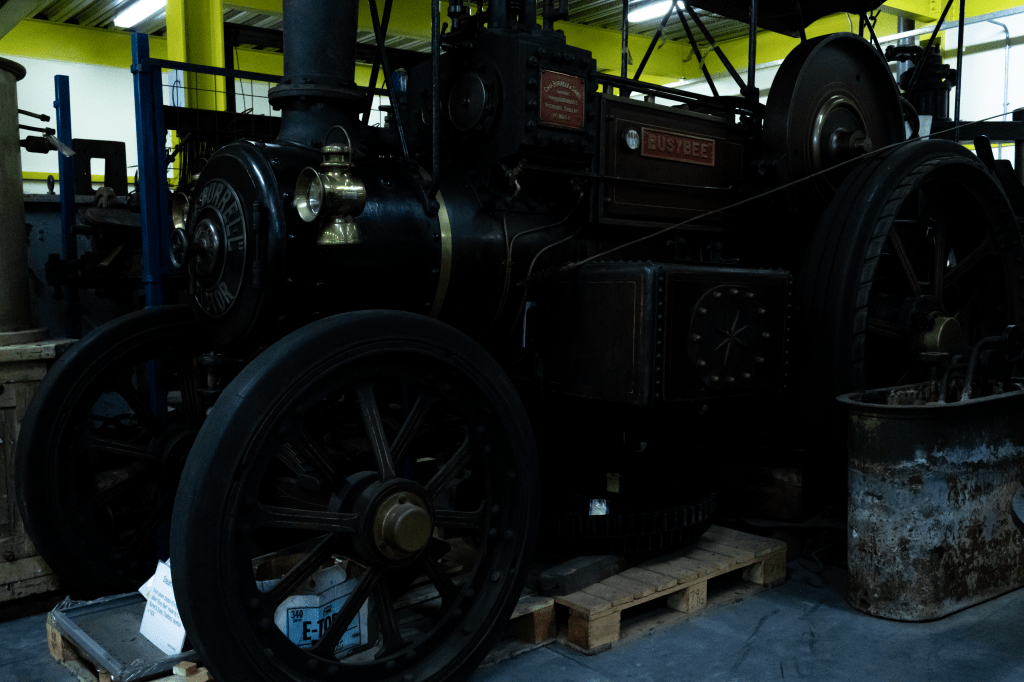
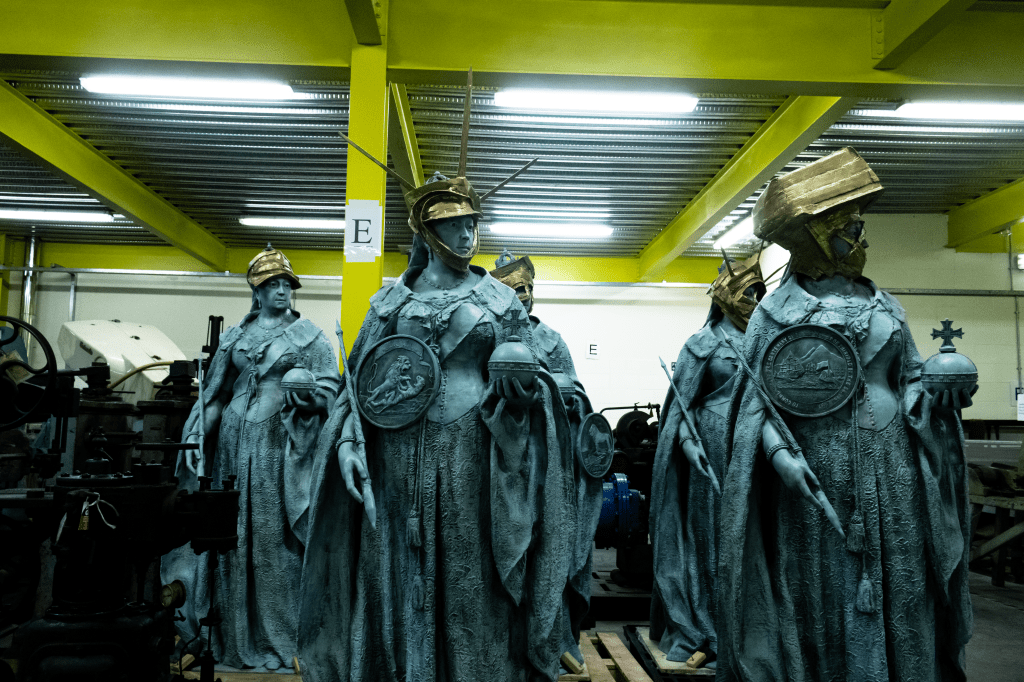

Then the personal tour kicked off and I first saw the large row of shelves where the majority of the larger items in the collection are stored, but even larger items such as Hew Locke’s Foreign Exchange (2022) and a variety of old transport are stored in an open area of the warehouse. Public tours do take place and this part of the collection center is where they take place. It is arranged for this purpose.
The most surprising element of my trip was the level of taxidermy within the collection…there is shelves and shelves AND SHELVES worth of animals preserved within the collection. Even someone’s cat. I was aware there was taxidermy within the collection and even suggested it would be good to see some of them as a part of a visit as animals are an intrinsic part of my practice, storytelling, and symbol within folklore. I’m not criticising the collection for taxidermy, I’m sure natural history has probably been beneficial, but it doesn’t change that it is difficult. I was actually fine until I saw the domestic shorthair cat, and then I froze, not wanting to go forward. This is problematic for me as a vegetarian and lover of all (most) animals, but it brought me back to the reality of these animals turned objects. It looked like the cat I see in my garden and have tried to befriend since I am often apart from my own cats who live with my mother. It let me pet it the other day and tried to storm my house. Now, static fur, petrified tail, she must be so dusty. She must be so cold.
Then after the tour, we went to the part of the archive where the metals are kept, which is literally kept behind locked bars! Oh, man. I got to hold (with gloves) the Glascote Torc!
The Glascote Torc was discovered in 1948 by S. Bates and G. Croshaw in a sewage trench of a boat building yard by the Coventry Canal. This is between Glascote and Amington. It was cleaned and polished by Sidney Bates and kept in his wardrobe until February 1970 when Bates’ wife, Grace, saw a program on the 1968 discovery of the Ipswich Torcs and realised what was in her husband’s wardrobe. It was promptly reported, declared a 1-pound gold alloy treasure trove dating back to 100BC-100AD, and bought by the Friend of Birmingham Museum and Art Gallery for £7,500. What I found particularly interesting and would love to know more about was that I read a passing reference to the effect the Torc had on the relationship between Bates and Croshaw. Croshaw is hardly mentioned in the story of the Torc and apparently, it caused a rift between the two of them. This is a theme I have noticed when the treasure is discovered by two people; money and fame are more powerful than the bond and it never heals.
£7,500 in 1970 is worth £143,072.00 today. I have no idea who got it and if it was even divided up. Maybe it was Mr Croshaw who was mad, I wouldn’t blame him.


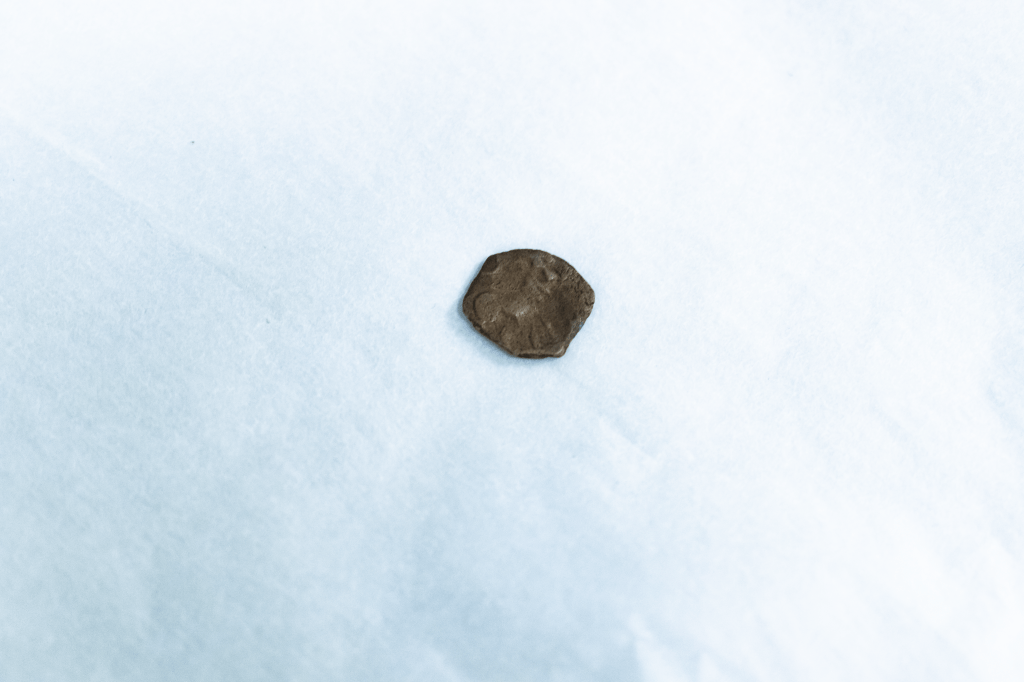

Then I spent a large amount of the visit looking at each individual Celtic coin within the Finney coin collection. I’m not really sure what to think yet. They were smaller than I expected, some were thicker and some were very thin. Very different from the modern coin and yet still so similar after all this time. I think there is probably something to be said about understanding heritage through coins. The tangibility of culture through currency is ironic to my own beliefs, it’s probably why seeing the Torc was such an important moment. It’s social history. Someone wore that, they earned a rank, a craftsman made it, and someone found the metal in order to make it. But the coins are still a representation of culture. I saw so many different animals from pigs to horses to some kind of pegasus beast, with astrological markings. Stars and flowers. It’s not just about rulers. It was especially touching to see them after a 2,100-year-old coin, which is one of three coins found to bear the name of Esunertos, a male British ruler in 1 BC, was auctioned off for £20,400. A new world record. I found it kind of heartbreaking to see such an important item of history enter public knowledge and exit public ownership into a private collection so very few can enjoy it. It doesn’t settle with my spirit at all.
I sent the rest of the visit to the paper archive, which has everything that can be known about each item in the collection. Most of the documents are just memos by the Museum on acquiring and learning about the items so there was a lot of wade through before getting to what was actually relevant. Although I really struggled with the papers on the Finney coins. I couldn’t really find out much about him as a person, why and how he collected, and the extent of his collection. I found his passports though. He died in 1993, which is when and how the Birmingham Museum Trust acquired his collection. I held his books where he recorded who he bought his coins from, where they were found, what it was, and how much he bought them for. It was so strange and cool. I’ve always had a burning desire to be nosey. I know to always hold back because I don’t want to be rude, but man! I want to look through every single paper folder in that entire room. It’s a tangible part of the object’s history to see all these old memos from over 50 years ago, asking people to weigh items, thanking them for doing so, asking experts to give their analysis, and their subsequent analysis reports. It’s all so interesting. I have no idea what to do with it but I need to know it all now!
Unfortunately, I cannot include my photos of the Torc and several of the coins as I had a tragic incident with my SD card and tried to retrieve what I could but I could only save 38 photos of the 370 photos I took during the visit. It has been extremely difficult to process and reckon with as those images were extremely important for this fellowship. Luckily, I have 3 more visits to the collection, which means 3 more visits to make up for what was lost. I still have my memory and notes, it’s just a shame I have little documentation. My second visit is next week and I plan to view as much as I can of the Pinto collection and re-document the Torc.
I think the next port of call for this fellowship is to visit the Weoley Castle site and then request to see as many items from that collection as possible. It’s a strand of interest I need to explore as it’s where I live now and I’m enjoying collecting all the stories that surround these artifacts. I still need to go to the library. All in good time I suppose. There isn’t a rush!
One thing that caught my eye is the endless intricately carved love tokens within the Pinto collection. Does anyone carve their lover a Welsh Love Spoon to eat some simple porridge anymore? It’s something I’ve been thinking about a lot as a woman, a single woman, trying to navigate this current tinder/hinge landscape. Everything is so disconnected and yet we still sing our hearts out to Taylor Swift’s He Is in Love. Has he ever been in love? Why is that the captivating movement when time stands still, his moment of realisation, because it’s so rare? We must celebrate every inch of attention he grants us after waiting on the phone every day and night. I’ve been there, I was an 18-year-old girl once. But now I’m 22 and grown, or more grown at least. I still remember that girl, I blamed her for her naivety when it came to men. I blamed her for her hope and where it got me, where it left me.
Michael Liked You.
Rupert left a comment, press to read.
Laura matched with you, but she will never reply.
Great, but who will betrove me a Busk Love Token for my Stays? Not even my woes? I fear I’ll never be a Sabbath child who is bonny, blithe, good, and gay.
And then I heard “She Used To Be Mine” by Sara Bareilles on the bus and I remembered that girl. I remembered how everyone blamed her for where she was left. I remember she blamed herself. I never remembered anyone blaming the man. I never remembered his life not moving on. His mind. His memories. He was not in love, life moved on.
I remember this girl. I remembered this girl when I was told my dark henna meant my future love would love me a lot and realised her hope had embers amongst the ash.
I wonder if she will ever receive an ornate mole trap or a knitting sheath with a cat on top.
It reminds me of a Reel (I know, soon we’ll be citing them) I saw where the sound says something kin to “You’re absolutely perfect, but I want to see if I can find something better.” What will you make for the better woman who only exists within your gaze, an intricate itch comb? I suppose these objects are symbols of another time when so much more was given up by women when they were ‘in love’ but I think we can find a narrative where unconditional gestures of affection attached can co-exist with love, acceptance, and equality. When will this tax return of love be seen too?
Another thing –
The idea you had of me, who was she?
All my love,
Mads
P.S. I’ll update you next time on what I’ve been making xxx
 Mads Washbrook