
Vibes: We are all eating each other by Juliet Ivy
12/12/2023
Fellow Reader,
It’s been a while, so much so that I should be writing my fifth post by now, but I’ve been pondering on my thoughts and feelings after my second MCC visit. I have so many things to tell you, so this is basically two posts in one! I hope you enjoy reading and read until the end.
Glascote Torc (again)
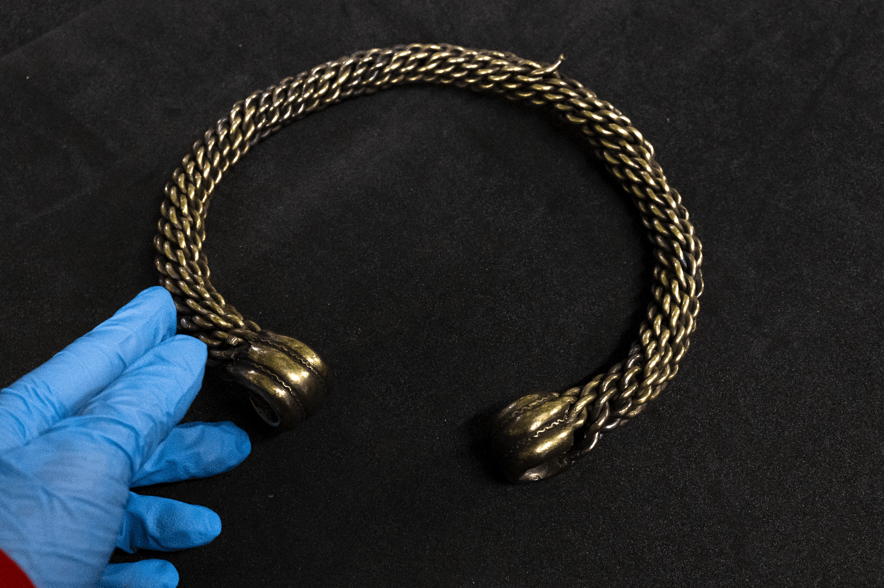
I had a second visit to the Birmingham Museum Collection Centre on the 27th of November with two priorities; to view the Glascote Torc again to redocument from my previous visit and view a large range of the Pinto collection. In seeing the Torc again, I was mostly thinking about getting as much documentation of the object as possible, but this time, I couldn’t help but notice the breakage in the Torc more than I did before. Perhaps the awe I was feeling when I first saw it has worn off and I truly see what is in front of me. In holding it, I noticed a bit of movement caused by the damage from when it was being used, as the Celtic Chieftain would have to bend the metal to put it on. With a combination of warrior power and the weakness of gold alloy, it buckled with a dramatic blow that makes it look like it survived a battle like the Carabinier’s breastplate from the Waterloo battlefield. There is a beauty to its fragility as we carefully (with gloves) retrieve and return it to the box it is stored in, surrounded by a sea of tissue paper. It is almost humorous that it was retrieved from a sewer and kept in a wardrobe for almost 30 years from 1948 to 1970.


Changing Thoughts on Love and Love Tokens
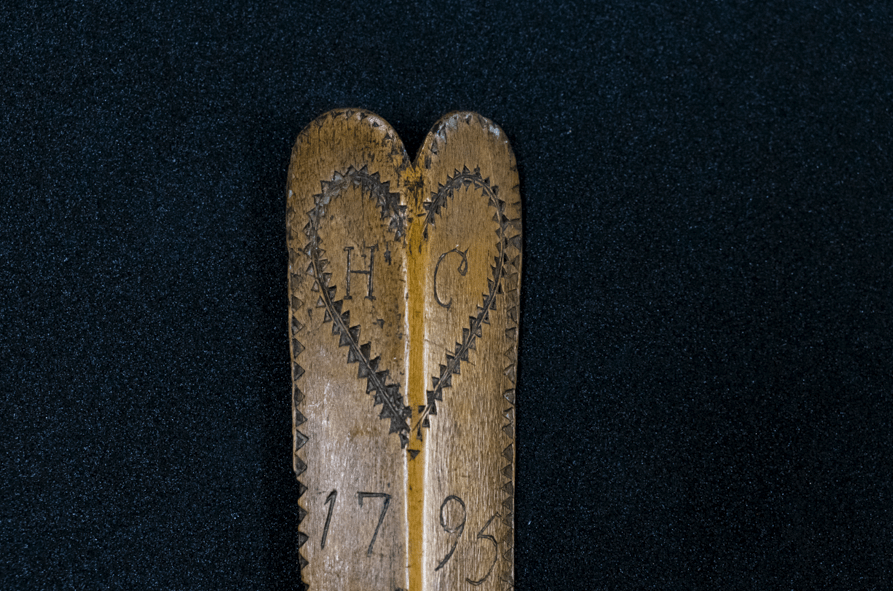
I have been thinking about how beautiful it is to see these surviving testaments of love 200+ years later. I wonder about their stories and how bittersweet it is that the objects intertwined within their story outlast their love. Humans are very cute and there is so much power in holding onto that love, that be romantic or platonic.
I have been wandering through thousands of photographs and yearning for the stories behind two letters infinitely tied together in time and history with a plus symbol in holy matrimony of Treen. There is an infinite combination and a thousand stories of love from over 200 years ago, did they make it to the end? Were they happy? Where did they bloodline go? Were they good people? A million thoughts race and see who wins.
Obviously, no one is still alive.
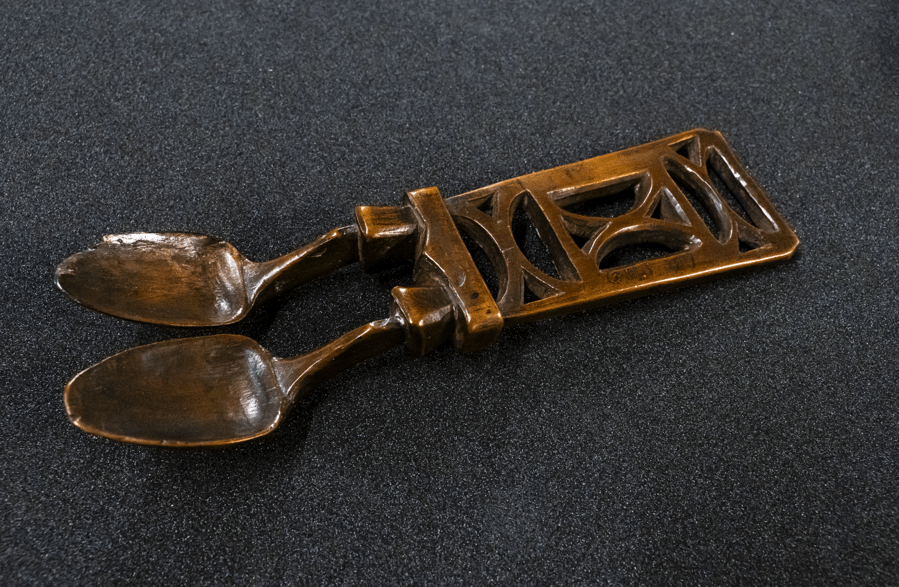
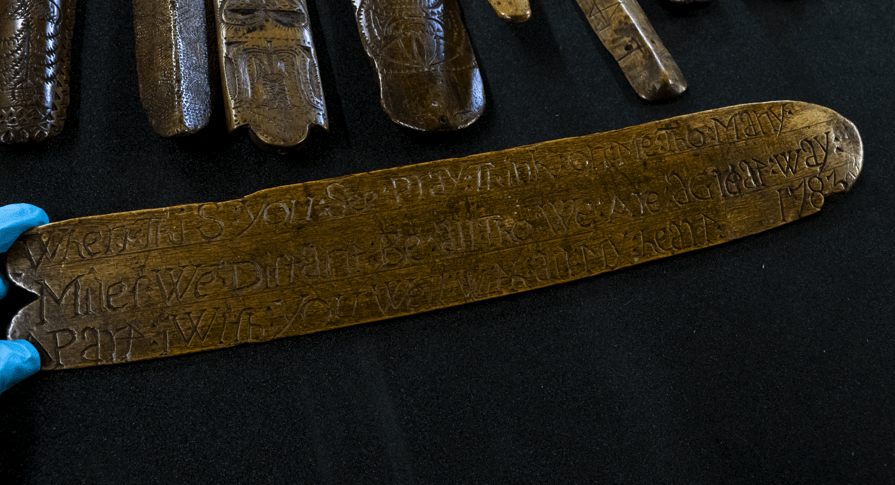
Which is obviously sad but ultimately inevitable in the process of life. I find it more amazing that these items live on and meet me here at this moment for me to handle them. These could be easily forgotten and disregarded for their impracticality or lack of usefulness as we no longer where busks; there is so much personal and social history lost for this reason and for a thousand other reasons. It’s a testament to the importance of personal collections outside of the capabilities, focus, or goals of museum institutions as these love tokens are in the Birmingham Museum Collection because Edward and Eva Pinto collected such a vast array of objects, of folk artifacts. Without repeating what I have already said about museum institutions’ attitudes towards it, it is so precious that these social histories are preserved. While not all their history can be known regarding who gave it to whom and what occasion it was gifted upon, its presence is a testament in itself. A testament of love over time.
These ghostly lovers live on, stalking the halls of the Birmingham Museum Collection Centre, and tentacularly bonded by a stay busk love token or an intricate and wildly impractical spoon. Gosh, I hope they liked each other and didn’t die bittering.

Politics of Archives
I think measuring this love with length to denote value is unproductive. Nothing lasts. But it’s important where our hearts and love are, these stories of love stand the test of time in one form or another. Love and value of history, of one another, of culture. It is these processes and actions that we need now more than ever before. It would be remiss to ignore how my practice’s intentions are aligned with what is going on in Palestine at this current moment. My outrage over Carnac and the Sycamore Gap would be selfish if I was not outraged over the destruction of Palestine’s Central Archive of Gaza City, multiple libraries, museums, and historical sites; in particular the destruction of the Great Omari Mosque and The Church of Saint Porphyrius. These are some of the oldest religious sites in the world, Palestine as a historical and holy site is rich with history, to say the least, and this is a soul-crushing loss to the historical world. It should be anyway. I don’t see the type of outrage over these losses as I did for Notre Dame or the Sycamore Gap. My tears have been the same, and my anger has been the same. It is a similar issue. It will always be in the back of my mind that as I celebrate Birmingham’s privilege to preserve history, Palestine is losing the privilege to preserve its own.
It should be treated the same, but the reality is that it is not. This is hypocritical.
The Sycamore Gap tree is only 200 years old, and Notre Dame dates to the 12th Century. The Great Omari Mosque dates to the 7th century (rebuilt in 1360)! The Church of Saint Porphyrius is almost the same age as Notre Dame. The eradication of Gaza has been brutal to the history of not only one religion but also Christianity, Islam, Judaism, and several historic religious communities becoming extinct in a matter of days. Besides history, it is difficult for anything to survive as Gaza, Palestine, is reduced to rubble.


You might be interested to know that the Birmingham Museum Collection has a few Palestinian items that I am just discovering while writing this.
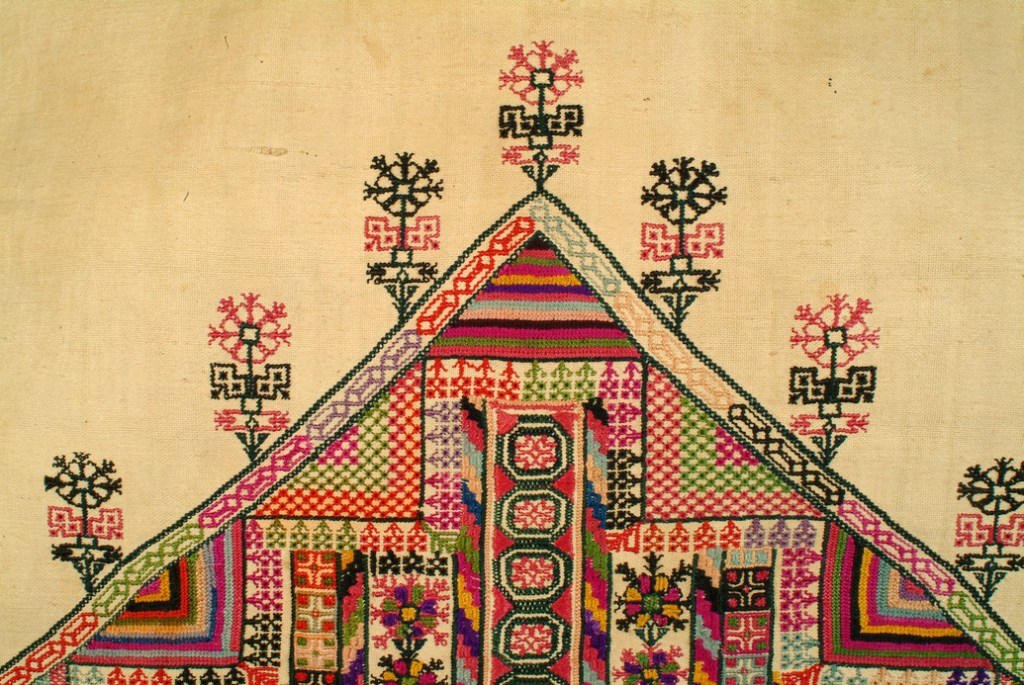
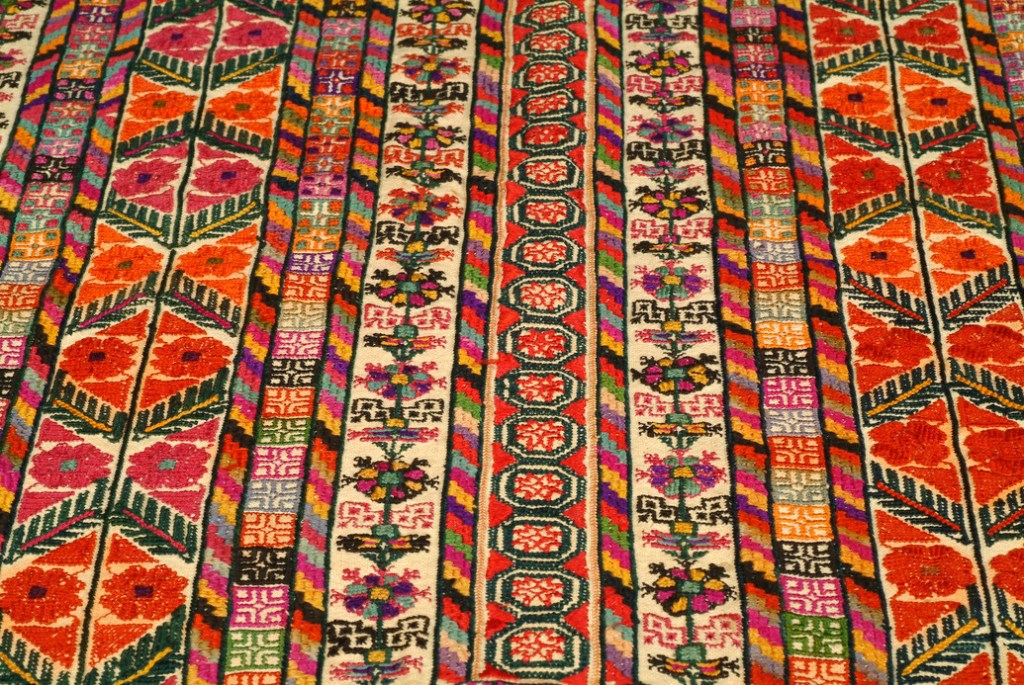

- A woman’s dress (Thob) from Ramallah, Palestine. Dating to 1800-1900.
It was acquired in 2003 as a part of the Wilfred Southall Collection.
It is an intricately embroidered dress full of colour and patterns, it is typical of traditional Palestinian textiles.
It is described like so:
“Full-length woman’s dress made of unbleached cotton embroidered in coloured silks. Pointed triangular hanging sleeves. Small round neck slit to about waist level, edged with quilted cotton and outlined in two rows of black backstitch with a white row in-between. The slit is bound and faced with pink cotton. Two neckties are of twisted cotton thread with multi-colored tassels. The seam across the sleeve and the seam to its sloping side have a filling of yellow embroidery in yellow with geometric patterns in crimson, pale blue, pink, orange, black, brown, and purple. The sleeves have embroidered borders along the edge and along the seam using the above colours. The border edging of the lower sleeve is different from the edging of the upper part. All are mainly in fine cross-stitch and employ geometric and plant forms. At the front of the robe is a wide area of elaborate embroidery, straight-sided to hip level, the slopes to a point beneath the neck slit. Worked in elaborate vertical strip patterns, again using geometric and plant forms in a wide variety of brilliant glowing colours. The main stitches used are fine cross stitch, half cross stitch, and satin stitch. Either side of the embroidered panel is a seam worked with an insertion in needle lace stitches.”
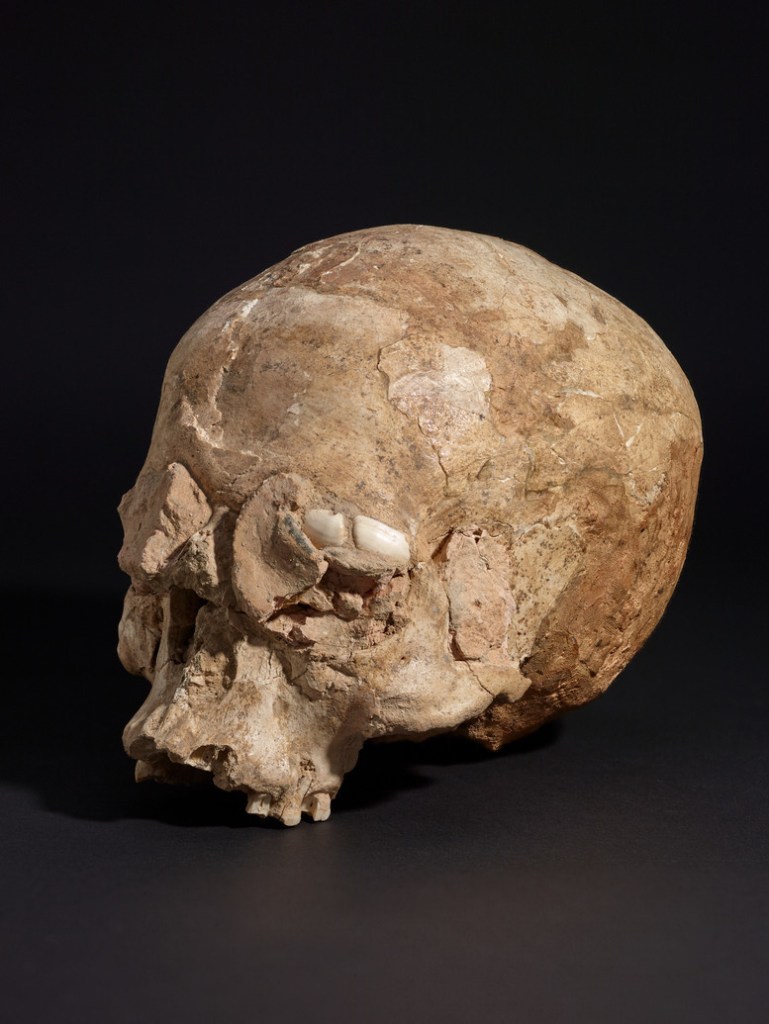
2. Plastered Skull
Plastered Human Skull, Pre-Pottery Neolithic B (c.8800–6500 BC)
From Jericho / Tell es-Sultan, Palestine
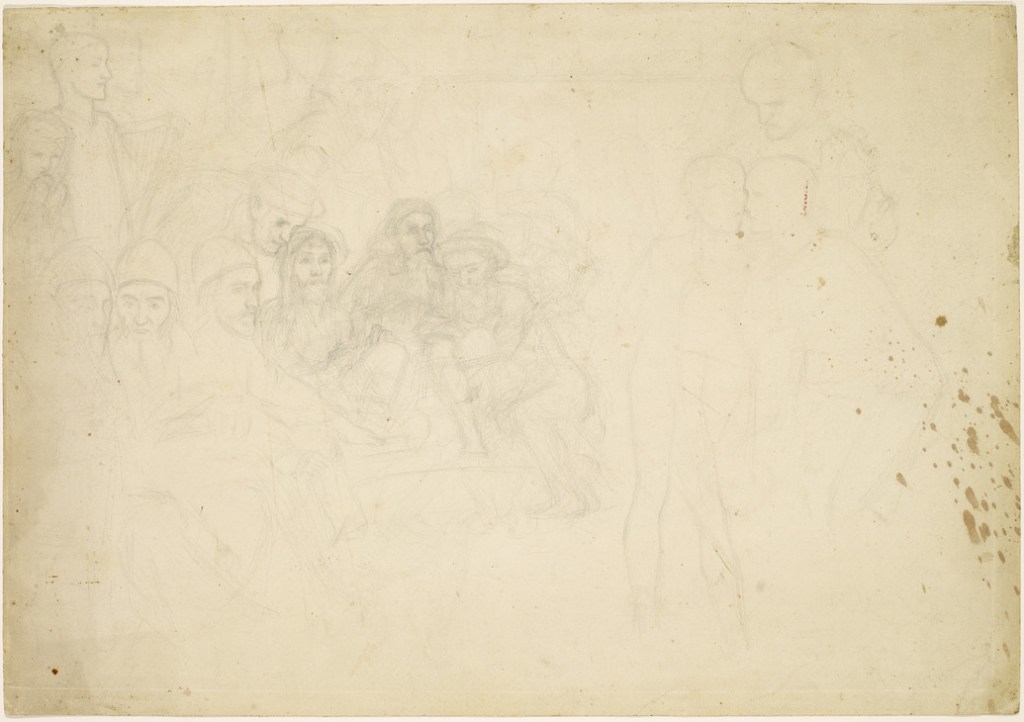
3. The Finding of the Saviour in the Temple – Study of Rabbis and Attendants with the Holy Family
The Finding of the Saviour in the Temple – Study of Rabbis and Attendants with the Holy Family, 1854-55
William Holman Hunt
Drawing based in Palestine.
Myths of objects and how they change the labels of objects.
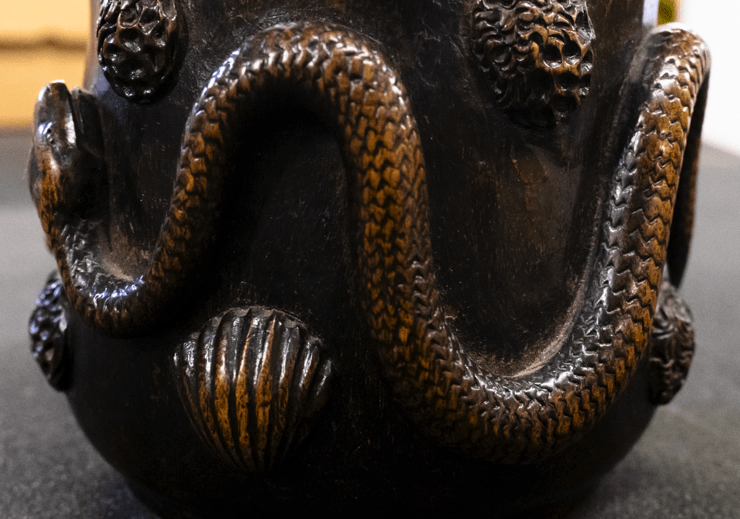
A moment in my visit was when I was able to view the “Witches Brew Bowl” from the Pinto collection and something I spotted in Edward Pinto’s “Treen and Other Wooden Bygones” (1969).
Its an interesting artifact and an amazing piece of craftsmanship, as are all of the items in the Treen collection, especially the spoons and apple corers with moving balls inside (which I imagine are for balance, like a spirit level?). This bowl is adorned with a snake, snails, frogs, and a lizard. It is not difficult or a foot of imagination to conclude why this cup was labeled this way but we must be honest. This is not a Witches’ Brew Bowl. It is most likely some kind of apothecary bowl for bleeding or some other function. It is labeled this way probably because of the combination of natural imagery we have come to associate with ‘Witchcraft’. This was a part of Pinto’s process. He generally bought things for their handcraftsmanship and relation to ‘Treen’, stories get passed around and surround these objects, so they became a part of their labeling. It wasn’t necessarily based on historical accuracy, let alone any research. So, these myths persist through word of mouth.

I was recommended to look at a plate/bowl made by Bernard Palissy in the late 16th century, purchased for the Collection in 1951. It is objectively gaudy and crass, but an interesting object for its creation and imagery. Apparently, Palissy used life casting, where he used some of the actual animals on the plate to cast from. Other animals are a bit skewed in size so we can assume this method was used for some but not all. It is very vibrant with bright dark blues, greens, and creams, but messily glazed and rather “rustique” as the museum placard describes it. I was also shown a cup from the Victorian era which looked normal on the outside but had a surprise frog on the bottom side so when you drink it, the frog is revealed. I have a similar, modern version so its fun that this humorous tradition persists.
But a witchcraft narrative does not surround Palissy’s work like the Apothecary cup. I suppose this brings us back to human stories and interrelations tied to artifacts and how they change our relationships or what they say about us. Perhaps the interpretation is the methodology of wood vs. ceramic, the colour palette, or that we know who made Palissy’s dish, while we don’t know who made the Brew Bowl. To me, there is certainly something peculiar about the Palissy dish as these animals swarm and become a natural multi-species entanglement on the surface. It’s an inspiring and relevant image as a social historical item and piece of art. Palissy most likely chose these animals and objects to test his skills, but this combination constructs an interesting folkloric meaning of nature and co-existence.


Other Projects
The research group I am a part of, Athena, continues to have an advanced influence on my practice with our discussion meetings, manifesto, and emerging projects. It’s a positive structure outside of academia, which has been a struggle to get used to. While the fellowship has also been a safety net, it is all still an adjustment that I think I am only just getting around to after 3 months post-post-graduation. With my graduation on January 5th, that will feel like the final goodbye to traditional academia for the time being until I aim to start my PhD in 2025. This fellowship is the playground for those ideas and research. After graduation, I will be embarking on a residency with Birmingham Open Media for their Immersive Arts Bootcamp and aim to develop these ideas for narrative, film, and interactivity/community within that residency. My idea, at the moment, is to recreate a site, of either historical or Pagan significance for the audience to explore and hide a story within that of clues. It depends on how much I can learn and achieve in 3 months! I want the residency and what I make at BOM to exist alongside and complement this fellowship as it introduces another commitment to my practical plate, and I find it more productive for all these practice strands to coincide with one another.
I was thinking of that place being Weoley Castle as it is a local, destroyed monument. I was thinking of the site being used for a film but I was uncertain about what angle to take, so I think transforming the site into the digital, to be explored and uncovering items from the Museum Collection on the site could be rather interesting!
“The fascinating ruins of Weoley Castle date back more than 750 years old and reveal the remains of a fortified manor house originally built as a hunting lodge by the Lords of Dudley. Set in the heart of what was once a thousand-acre deer park, the grounds extended almost as far as the city center.
The ruins seen today are believed to date back as far as 1270, making it one of the oldest buildings still visible in Birmingham. As such it was classified as a scheduled Ancient Monument of National Importance in 1934 and a series of archaeological digs in the 1930s and 1950s uncovered a rich collection of historic treasures.”

Circling back to Athena, I have begun to have conversations and started to plan a large research project for a publication as a sub-group called The Changelings, with two fellow Athena members and artists. Spite and Deoffal Maldoror. There is only so much I would like to reveal about the project publicly, but I wanted to mention it as it will be an important part of my research and practice moving forward. We will be focusing the book on folklore as it is a common interest between the three of us, which will be combined within prose, poetry, and illustrations.
Fellowship Output:
In terms of studio output, I have bought a roll of Lino, 90cm x 200 cm and I aim to transform this into one printing block which depicts an epic and I plan to print this onto a banner of fabric.
I’ve also been experimenting with smaller sizes of Lino, ranging from 5cm – A2, and plan to experiment with symbols, images, and storytelling. I would also like to develop a repeated image icon for my practice as a logo. I’m not sure why, I just think it would be cool for my website, branding as an artist, and recognizability.
Next Steps for 2024
Moving forward with my commitments to the fellowship, and work at Ikon Gallery and BOM, I also plan to dedicate more time, energy, and resources to making my studio a more productive space. I plan to move into a larger space within Lombard Method as a sole occupier! My first, very own studio! Alongside some further job plans, I’m hoping to invest more into kitting the place out with a rug, comfortable seating, materials, and a printing press! I would really like to get an A2 printing press as it would be more practical for a variety of sizes, but I think I might have to settle for an A3 for now. We will have to see!
In the early new year, I aim to take my third and fourth visits to MCC, with the fourth being my final visit as I am allowed four visits in total. This will conclude the main portion of the research into the archive and then the rest of the four months will be focused on developing my studio, printmaking, the Changelings project, and the BOM residency. It will be a lot, but it will be worth it!
All my love,
Mads xx

